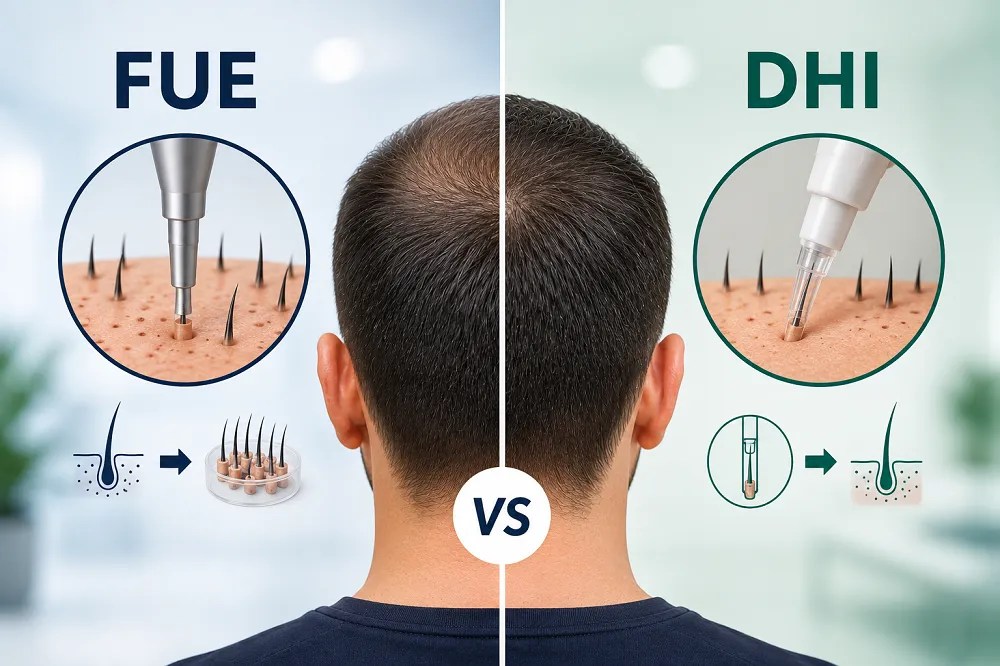
Hair loss can be frustrating, especially when thinning hair starts affecting your confidence, hairstyle, or appearance. If you are considering a hair transplant, you have probably come across terms such as FUE and DHI hair transplant. Both are commonly discussed in modern hair restoration, but what is the actual difference?
More importantly, does DHI always produce better results than FUE?
The answer is not that simple. Choosing the right approach depends on your hair-loss pattern, donor hair, desired density, hairline design, and the experience of the medical team performing the procedure. Understanding the difference can help you make a more informed decision instead of choosing a technique simply because it sounds newer.
What Is an FUE Hair Transplant?
FUE, or Follicular Unit Excision, involves removing individual follicular units from the donor area—usually the back or sides of the scalp, using a small surgical punch. These grafts are then prepared and placed into areas affected by hair loss.
Unlike FUT, which removes a strip of scalp, FUE does not leave one long linear scar. Instead, it can leave numerous tiny scars in the donor area that are generally less noticeable when the procedure is performed properly.
One of the major advantages of FUE is its flexibility. Individual grafts can be selected and distributed strategically to create a natural-looking hairline and improve density in thinning areas.
However, FUE is still a surgical procedure. The quality of the result depends heavily on graft handling, donor-area management, extraction technique, recipient-site design, and the skill of the surgeon.
What Is a DHI Hair Transplant?
DHI stands for Direct Hair Implantation. It is important to understand that DHI is not necessarily a completely separate hair-transplant method.
According to the International Society of Hair Restoration Surgery (ISHRS), the term DHI is used by some practitioners to describe immediate implantation of a follicular unit after extraction or implantation using a sharp implanter. ISHRS specifically notes that DHI is an implantation technique rather than a distinct hair-transplant method.
In a DHI-style approach, extracted grafts are loaded into an implanter device and inserted into the recipient area. The implanter can help control the placement, angle, and direction of individual grafts.
This can be particularly useful when the treatment requires careful placement around the hairline or between existing hairs.
FUE vs DHI: What Is the Difference?
The easiest way to understand FUE vs DHI hair transplant is to look at the extraction and implantation stages.
With FUE, individual follicular units are harvested from the donor area. The grafts are then prepared and implanted into the recipient area using an appropriate implantation method.
DHI generally refers more specifically to the implantation stage, where an implanter is used to place grafts into the scalp.
So, rather than thinking of FUE and DHI as two completely competing procedures, it is more accurate to understand that FUE can be the method used to harvest grafts, while DHI can describe a particular way of implanting those grafts.
This distinction matters because some clinics may market DHI as automatically superior. There is no universal rule that one technique is best for every patient.
Which Is Better: FUE or DHI?
There is no single answer.
For some patients, an implanter-based approach may offer advantages in controlling graft placement and potentially reducing direct handling of the graft. ISHRS notes that implanters may reduce direct handling of the follicle bulb compared with forceps.
However, the final outcome is not determined by the name of the technique alone.
A natural hair transplant requires much more than simply moving grafts from one area to another. Your surgeon needs to evaluate:
- The pattern and progression of your hair loss
- Donor-area density and quality
- Available graft supply
- Hair thickness and texture
- Existing hair in the recipient area
- Hairline shape and facial proportions
- Desired density and realistic expectations
- Long-term plans if further hair loss occurs
The American Academy of Dermatology also emphasizes that the outcome of hair transplantation depends largely on selecting a doctor who understands hair loss and regularly performs hair-transplant procedures.
FUE vs DHI: Recovery and Results
Both approaches are performed with the goal of achieving natural-looking hair growth, but patients should understand that transplanted hair does not appear fully grown immediately.
After a transplant, the scalp may experience temporary redness, swelling, scabbing, or discomfort. Some transplanted hairs may also shed during the early stages before new growth begins.
According to the NHS, new hair commonly starts appearing around four months after a transplant, while the full result may take approximately 10 to 18 months.
Your aftercare also matters. During the early recovery period, transplanted grafts need to be protected because they are not immediately secure.
Is DHI More Natural Than FUE?
Not automatically.
Natural-looking results depend on the planning and execution of the entire procedure, not simply whether an implanter is used.
The direction, angle, spacing, and distribution of grafts are particularly important when reconstructing the front hairline. Poor planning can produce an unnatural appearance regardless of the technique’s marketing name.
This is why you should look beyond terms such as “advanced,” “premium,” or “latest” when choosing a hair-transplant clinic. Ask who will perform the surgical parts of the procedure, what their qualifications are, how they assess your donor area, and whether they can show appropriate before-and-after results.
ISHRS states that hair restoration surgery involving scalp incisions should be performed by properly trained and licensed physicians.
How to Choose the Right Hair Transplant for You
If you are unsure whether FUE, an implanter-based approach, or another treatment is appropriate, start with a professional consultation rather than choosing based on price or a procedure name.
A qualified hair-restoration specialist can assess your scalp, determine whether you have sufficient donor hair, evaluate the cause and progression of your hair loss, and develop a treatment plan around your individual goals.
At Health360, patients considering hair restoration can explore the available approach and discuss their individual requirements with the hair-transplant team. If you are looking for a personalized assessment, choose Health360 for expert hair transplantation and learn more about the treatment options available at https://health360.pk/hair-transplant-pakistan/
FUE vs DHI Hair Transplant: The Bottom Line
When comparing FUE vs DHI hair transplant, remember that the two terms do not necessarily represent two completely separate procedures. FUE primarily describes how follicular units are harvested, while DHI is commonly used to describe an implantation approach.
The best choice depends on your individual hair loss, donor supply, hair characteristics, treatment goals, and, most importantly, the expertise of the medical team.
Don’t choose a hair transplant simply because one technique sounds more advanced. Choose a qualified specialist who can explain why a particular approach is suitable for your scalp and long-term hair-restoration goals.
Expert Tip
The best hair transplant technique is not the one with the most impressive name—it is the one that is carefully planned for your individual hair loss and performed by an experienced, properly qualified professional. Save this guide and share it with anyone comparing FUE and DHI before booking a hair-transplant consultation.


 Daily Best
Leave a comment